How to Identify and Order a Splined Component
An unidentified splined coupling, hub or shaft can be difficult to match by appearance alone. Several components may have a similar diameter or tooth count while using different spline standards, pitches or profiles.
Before ordering a replacement, collect a few key measurements and compare the complete specification.
1. Identify the component type
Start by determining what type of component you have:
- A spline coupling generally has an internal spline and joins compatible splined components.
- A spline hub contains an internal spline and has an outside profile that can be incorporated into another assembly.
- A spline shaft has an external tooth profile.
Identifying the component type helps narrow the product range before checking its dimensions.
2. Count the spline teeth
Mark one tooth as the starting point using a removable marker. Carefully count around the complete component until you return to the marked tooth.
Recording the starting point reduces the chance of counting a tooth twice or stopping too early.
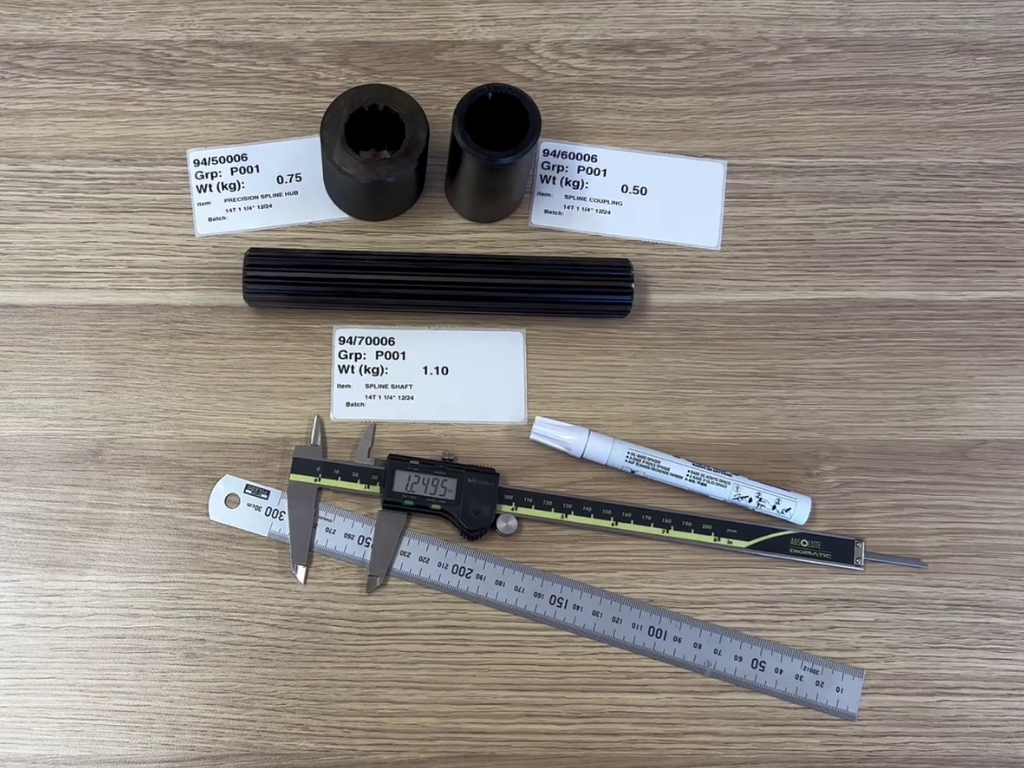
The example in our video has 14 spline teeth.
3. Measure the approximate spline diameter
Where an external spline is available, use vernier calipers to take an approximate measurement across its outside diameter.
This measurement helps identify the likely nominal size. It should not be used by itself to confirm a component, because the measured dimension may differ slightly from its published nominal size.
4. Measure the overall length
Measure the complete length of the coupling, hub or shaft and record whether your measurements are metric or imperial.
Overall length can distinguish between otherwise similar components. OEM Dynamics supplies some spline configurations in more than one length.
5. Confirm the complete spline specification
Compare the information you have collected with the technical specifications shown in the OEM Dynamics catalogue or website.
Check:
- Component type
- Number of teeth
- Nominal spline diameter
- Metric or imperial measurement system
- Spline pitch or module
- Tooth form and applicable standard
- Overall length
- Intended application, where known
The components demonstrated in the video share the following spline details:
- 14 teeth
- 1¼-inch nominal spline outside diameter
- 12/24 DP involute Class 5 spline
- Imperial ANSI spline
- Commonly associated with an SAE C hydraulic spline
A matching diameter and tooth count do not necessarily confirm compatibility. Always compare the complete specification before ordering.
6. Check matching components carefully
Where known matching components are available, gently align the spline profiles and check their engagement.
Never force two spline components together. A component that begins to engage is not automatically the correct match, and forced assembly can damage the tooth profiles.
7. Search and order online
Once the component has been identified, enter its OEM product number or any know details like the number of teeth into the search bar at oemdynamics.com.au.
The three matching components demonstrated are:
Open the product page, confirm the technical details, check availability and add the required item to your cart.
Browse splined components
OEM Dynamics offers a broad range of splined hubs, couplings, shafts and related power-transmission components.
BROWSE SPLINED COMPONENTS
If you cannot confidently identify your component, send us clear photographs together with the tooth count, approximate diameter, overall length and application details.
ASK OEM DYNAMICS FOR ASSISTANCE
Find it. Check it. Order it online.